Your boat’s appearance tells a story about how well you care for it. Over time, sun exposure, salt water, and general wear can make even the nicest boat look dull and tired. Understanding when to buff versus when to wax makes the difference between a boat that looks worn out and one that turns heads at the dock.
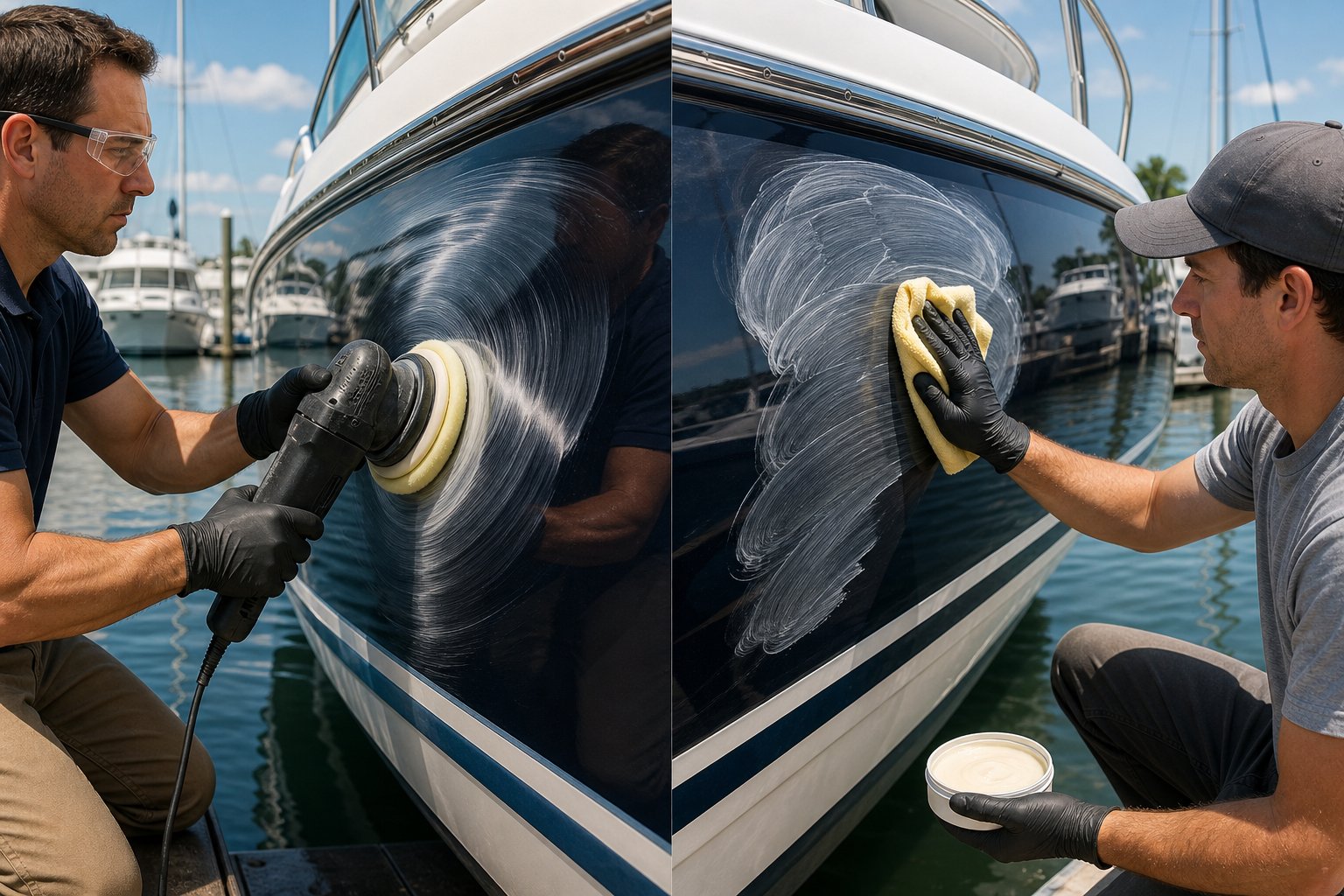
Buffing removes oxidation and surface damage using an abrasive compound, while waxing protects the surface and adds shine with a protective layer. The key difference between buffing and waxing a boat comes down to their purpose in your maintenance routine. You need both processes to keep your boat looking its best, but they work in different ways and at different times.
Most boat owners confuse these two steps or skip one entirely. Learning how each process works helps you save money on professional detailing while keeping your boat in top condition. The right approach depends on your boat’s current state and what you want to achieve.
Key Takeaways
- Buffing removes damage and oxidation while waxing protects and seals the surface
- You need specific products and tools for each step to get professional results
- Regular maintenance with proper techniques keeps your boat looking new longer
- Core Differences Between Buffing and Waxing
- Key Steps in the Surface Restoration Process
- Choosing Buffing and Waxing Products
- Tools and Accessories for Effective Results
- Proper Techniques for Buffing and Waxing
- Detailing and Maintenance for Lasting Shine
- Frequently Asked Questions
- What is the difference between buffing and waxing a boat's gelcoat?
- When should I buff my boat instead of just waxing it?
- Do you buff or wax first when restoring a boat's shine?
- Is buffing and waxing a boat harmful to the gelcoat if done too often?
- What type of compound or polish works best for removing oxidation on a boat?
- How much does it typically cost to have a boat professionally buffed and waxed?
Core Differences Between Buffing and Waxing
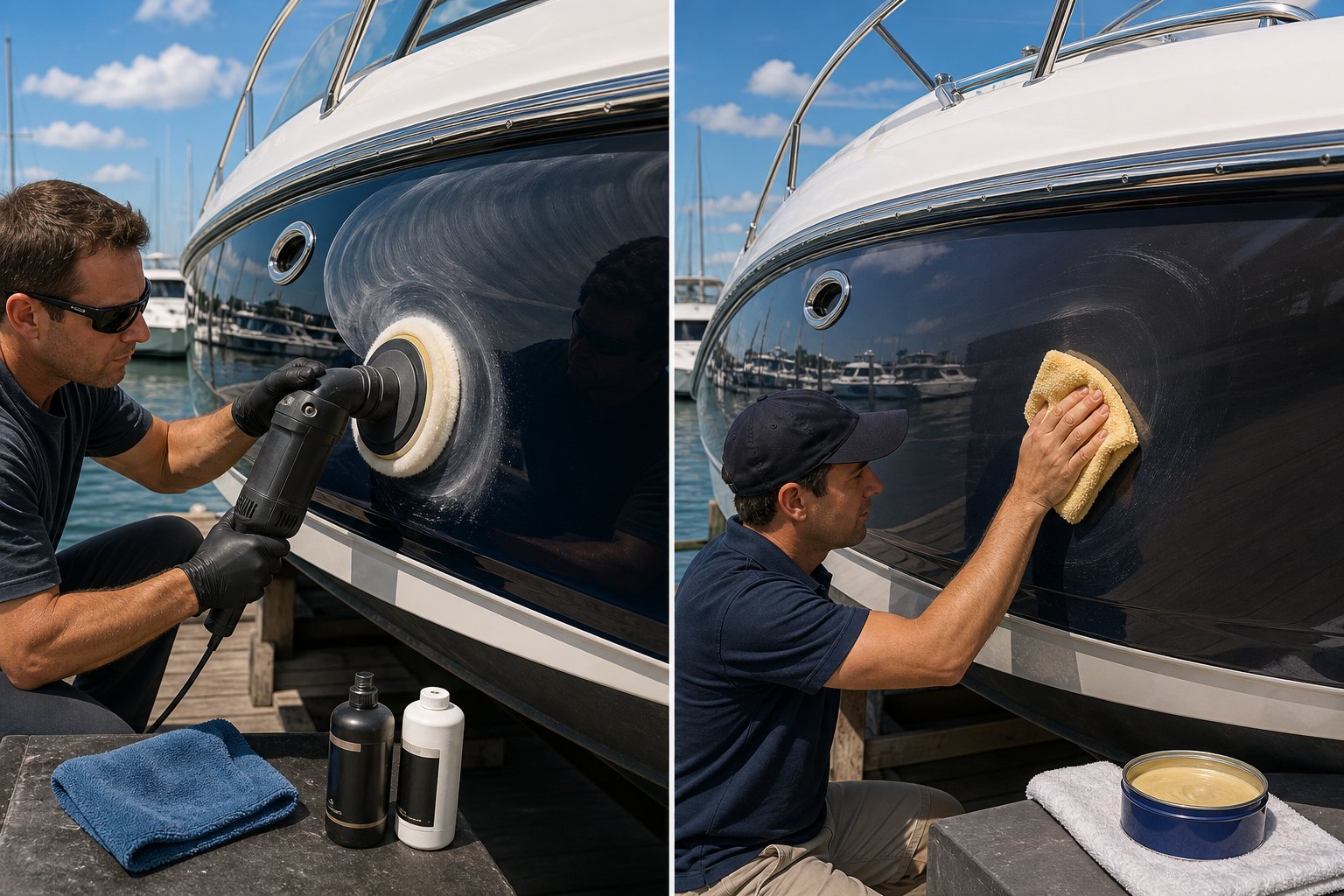
Buffing removes damage from your boat’s surface while waxing protects it from future harm. These two processes work together but serve completely different roles in boat maintenance.
Purpose and Results
Buffing a boat addresses existing damage on the gelcoat surface. When you buff, you use an abrasive compound to remove oxidation and scratches that make your boat look dull and chalky. The process physically removes a thin layer of damaged gelcoat to reveal fresh material underneath.
Buffing achieves:
- Removal of oxidation and discoloration
- Elimination of minor scratches and swirl marks
- Restoration of original color and gloss
- Preparation of the surface for wax
Waxing a boat creates a protective barrier on top of the gelcoat. Marine wax acts as a shield against UV rays, salt water, and environmental contaminants. The wax layer doesn’t fix damage but prevents new damage from occurring.
Waxing achieves:
- UV protection for gelcoat
- Water-repellent barrier
- Enhanced shine and depth of color
- Easier cleaning between wax applications
When Each Method Is Needed
You need buffing when your boat’s surface shows visible signs of damage. Check for a chalky white residue when you run your hand across the hull. Look for faded color or a dull appearance even after washing. These signs indicate oxidation that requires boat polishing before you apply wax.
Buff your boat once or twice per year if you keep it in harsh conditions. Boats in saltwater environments or intense sun exposure need more frequent attention.
You need waxing after every buffing session and regularly throughout the season. Apply boat wax every 2-3 months for optimal protection. If water no longer beads up on your hull, the wax layer has worn away and needs replacement.
New boats with pristine gelcoat only need waxing initially. Skip the buffing and waxing process together until oxidation appears.
Surface Protection and Longevity
Buffing provides no protection on its own. The process actually makes your gelcoat temporarily vulnerable by exposing fresh material. You remove the outer layer of gelcoat each time you buff, so excessive buffing can thin the gelcoat over time.
Marine polish sits between buffing compound and wax in terms of abrasiveness. It refines the surface after heavy buffing and adds minor protection, but you still need wax as the final step.
Waxing delivers the actual protective barrier your boat needs. A proper wax coat blocks UV radiation that breaks down gelcoat molecules. It prevents salt crystals from etching the surface and stops dirt from bonding directly to the gelcoat.
Quality marine wax lasts 60-90 days in normal conditions. The protection gradually wears away from washing, wave action, and sun exposure. Regular wax application prevents oxidation from starting, which means you need to buff less often over your boat’s lifetime.
Key Steps in the Surface Restoration Process
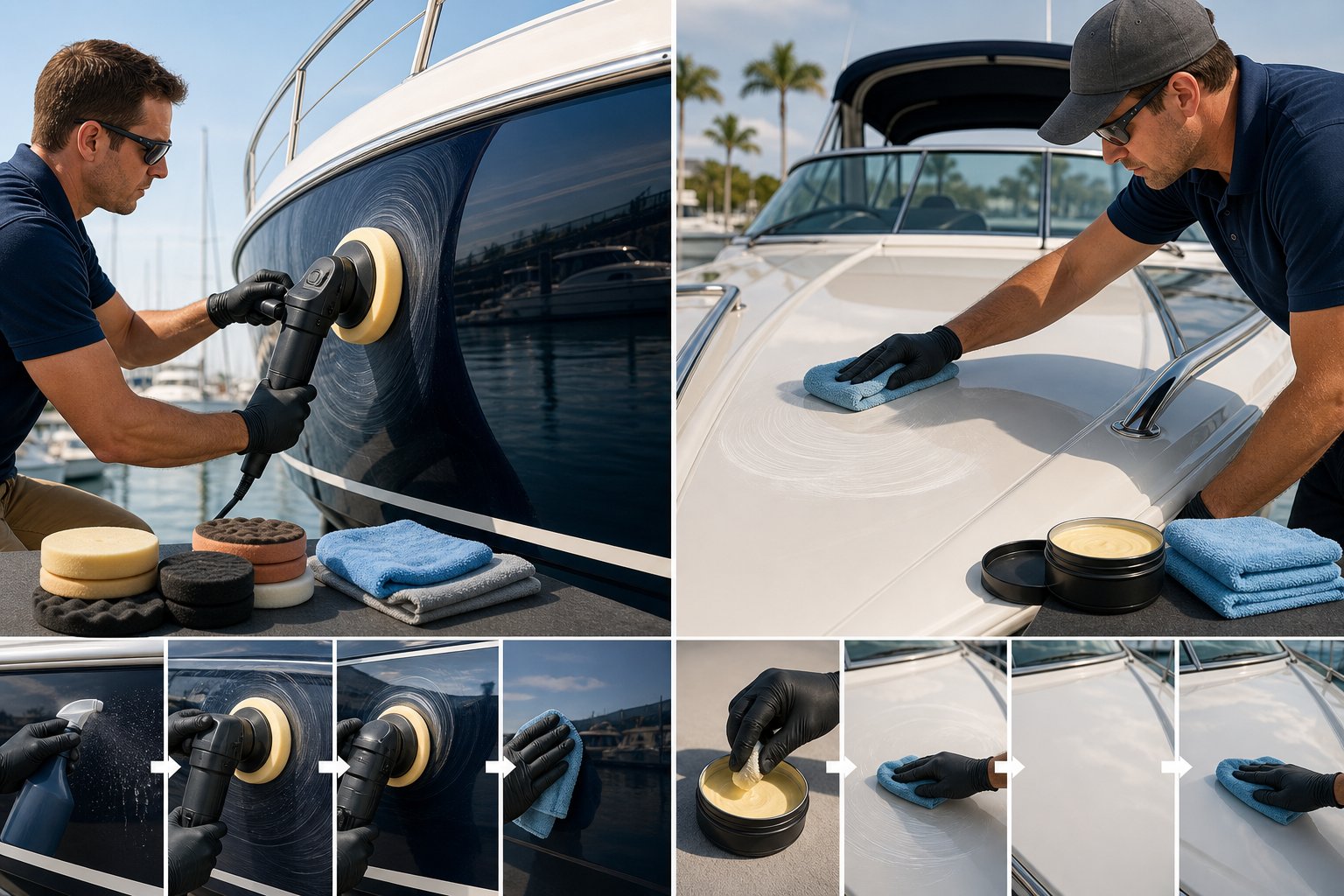
Restoring your boat’s gelcoat requires a systematic approach that builds from basic cleaning through aggressive correction to final protection. Each step prepares the surface for the next, creating a foundation that determines your final results.
Initial Cleaning and Prep
You need to start with a thorough wash using boat soap designed for marine environments. Regular car soap won’t cut through the salt, grime, and marine growth that builds up on your hull.
After washing, inspect the surface for stubborn stains or residue. A multipurpose cleaner can remove waterline stains and other marks that regular soap leaves behind. Some people use a pre-wax cleaner at this stage to strip away old wax layers and prepare the gelcoat for compounding.
Want to avoid costly fiberglass boat repair mistakes?
Learn how to inspect damage properly, decide when to DIY, and prevent expensive fiberglass problems before they start.
The surface must be completely dry before you move forward. Any moisture trapped under compound or wax will cause problems later. Work in a shaded area to prevent products from drying too quickly on hot gelcoat.
Buffing Out Oxidation and Imperfections
The buffing stage removes oxidation and surface defects that dull your boat’s appearance. You’ll need different levels of abrasiveness depending on your gelcoat’s condition.
Heavy oxidation requires a cutting compound or rubbing compound as your most aggressive option. These products cut through the damaged gelcoat layer to reveal fresh material underneath. A buffing compound offers medium correction for moderate oxidation and scratches.
For light imperfections, a polishing compound provides gentle correction without removing much material. Many people follow their compounding work with a finishing polish to refine the surface even further. This creates the smoothest possible base for your protective layer.
You can apply these products by hand for small areas, but a dual-action polisher makes the job faster and more consistent on large surfaces.
Finishing With Wax or Sealant
The final step protects all your hard work from UV rays, salt water, and environmental damage. You have several options for protection, each with different characteristics.
Paste wax provides traditional protection with a warm, deep shine. It typically lasts 2-3 months before needing reapplication. Liquid wax goes on easier and works well for regular maintenance between major details.
A polymer sealant offers longer protection than traditional wax, often lasting 4-6 months or more. These synthetic products bond to the gelcoat and create excellent water beading. Some people skip separate wax entirely and use a cleaner wax that combines light polishing with protection in one step.
Apply your chosen protectant in thin, even coats. Let it haze over, then buff it off with a clean microfiber cloth. Test water beading by spraying the surface—proper protection causes water to form tight beads that roll off easily.
Choosing Buffing and Waxing Products
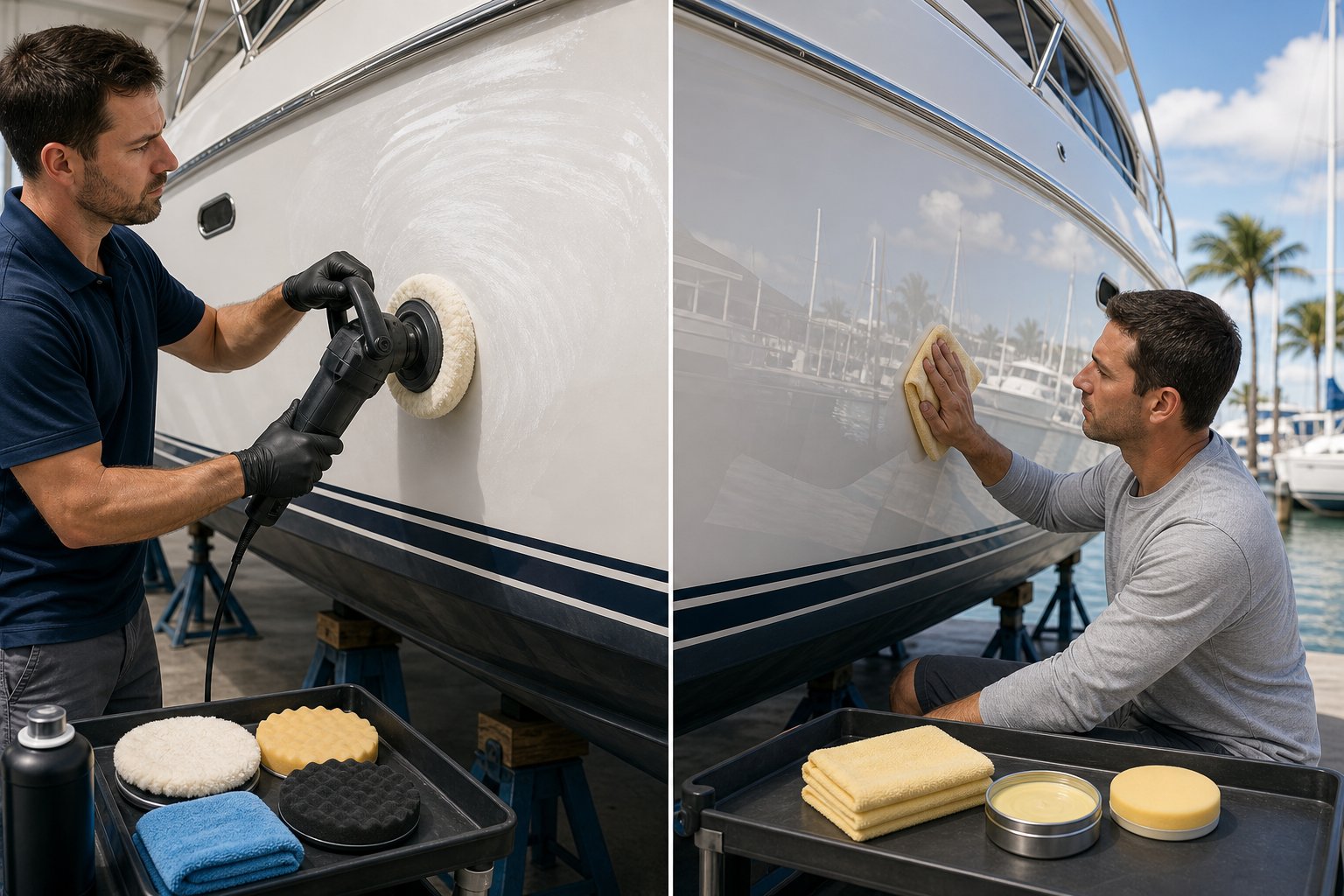
Selecting the right products depends on your boat’s condition and the level of correction needed. Different compounds remove varying amounts of oxidation, while waxes and sealants offer different protection levels and ease of application.
Types of Compounds and Polishes
Rubbing compounds and cutting compounds are the most aggressive options for heavily oxidized gelcoat. These products contain coarse abrasives that remove significant material to eliminate deep scratches and chalky surfaces.
Buffing compounds offer medium-level correction for moderate oxidation. They work well on boats that show some dullness but don’t need heavy restoration. Mirka Polarshine saves time when buffing large areas.
Polishing compounds use finer abrasives to refine the surface after compounding. They create a smoother finish and prepare the gelcoat for wax. Finishing polishes like 3M Finesse It II contain the finest abrasives for final surface preparation.
Start with the least aggressive product that achieves results. Each time you use abrasives, you remove gelcoat thickness. Water-based marine polish products like Aqua Buff contain no petroleum distillates, though they may not perform as well as traditional options.
Selecting the Right Wax or Sealant
Paste wax provides harder protection that lasts longer than liquid alternatives. Collinite 885 paste wax is a popular choice for durability, though it requires more effort to apply and buff.
Liquid wax applies easier and buffs off faster. Products like Mother’s liquid polymer deliver nearly the same longevity as paste wax with less work. Nu Finish is another liquid option that many boat owners prefer.
Marine wax formulations specifically resist salt water and UV exposure better than automotive products. Polymer sealants bond to gelcoat chemically rather than sitting on top like natural waxes. They often last longer but may not produce the same warm shine as carnauba-based waxes.
Benefits of Multi-Step and All-in-One Products
Cleaner wax combines mild abrasives with protective wax in one product. This saves time on boats that need light correction and don’t show heavy oxidation. You skip the separate compounding step while still getting decent results.
Multi-step systems give you better control over the correction process. You can match each product’s aggressiveness to specific problem areas on your hull.
All-in-one products work best for regular maintenance rather than restoration. If your boat has been waxed regularly and shows no oxidation, a single cleaner wax application may be sufficient. Boats with severe neglect need the full sequence of compound, polish, and wax for proper restoration.
Tools and Accessories for Effective Results
Using the right equipment makes buffing and waxing faster and more effective. Electric polishers deliver professional results, while different pad types handle specific tasks from heavy cutting to final finishing.
Electric Polishers and Buffers
A dual-action polisher operates with both spinning and oscillating motions, making it safer for beginners since it reduces the risk of burning through gelcoat. The DA polisher works well for light to moderate oxidation removal and applying wax. You can use it confidently without extensive experience.
A rotary buffer spins in one direction and removes heavy oxidation faster than other types. The rotary polisher requires more skill because its aggressive cutting power can damage gelcoat if you apply too much pressure or linger in one spot. Professional detailers prefer rotary buffers for severely weathered boats.
An orbital buffer combines elements of both styles and provides good results for maintenance work. Electric buffers with 120-volt motors deliver consistent power for uniform finishes across your boat’s surface.
Pad Materials and Applications
Wool buffing pads cut through heavy oxidation quickly when paired with rubbing compounds. Wool pads generate more heat and remove material faster than foam options. You should use wool buffing pad options only with rotary polishers for initial correction work.
Foam pads come in different densities for specific tasks. Cutting pads (firm foam) remove moderate oxidation, polishing pads (medium foam) refine the surface, and finishing pads (soft foam) apply wax or create final gloss. Each foam pad color typically indicates its aggressiveness level.
Microfiber pads work well for one-step polish applications and light correction. These microfiber pad options generate less heat than wool while still providing good cutting ability. You’ll find microfiber pads effective for maintenance buffing between major restoration jobs.
This guide helps boat owners understand fiberglass damage clearly — what matters, what doesn’t, and when repairs are truly necessary, so small issues don’t turn into expensive mistakes.
See What Every Boat Owner Should Know →Manual Application Tools
Microfiber towels are essential for removing compounds, polishes, and wax residue. You need clean towels to prevent scratching and achieve streak-free results. Keep separate towels for different products to avoid contamination.
Foam applicator pads let you apply wax by hand to small areas or tight spaces your buffer cannot reach. Hand application gives you more control around decals, trim, and hardware. You should always have backup applicators since they wear out with regular use.
Masking tape protects non-gelcoat surfaces like vinyl graphics, metal fittings, and rubber trim from polish splatter. Cover these areas before buffing to avoid staining or damage.
Proper Techniques for Buffing and Waxing
The right technique makes all the difference between a professional-looking shine and a patchy, swirl-marked mess. Your success depends on proper surface prep, controlled buffing motions, and systematic wax application.
Surface Preparation Strategy
You need to start with a completely clean hull before any buffing begins. Wash your boat with a pH-neutral soap and rinse it thoroughly with fresh water. Dry the entire surface with clean microfiber towels to prevent water spots.
Run your hand across the dried gelcoat. If it feels gritty or rough, you have embedded contaminants that regular washing won’t remove. Use a clay bar or clay mitt with lubricant spray to decontaminate the surface. Work in small sections and apply light pressure until the gelcoat feels glass-smooth.
Mask off everything you don’t want to touch with your buffer. Cover decals, pinstripes, non-skid surfaces, hardware, and rubber seals with painter’s tape. This protects sensitive areas from compound burns and keeps white residue out of textured surfaces.
Buffing Technique for Even Correction
Set your dual-action polisher between 1,500 and 2,000 RPM. Apply 5 to 10 pounds of pressure—just enough to keep the pad engaged without forcing it. Keep the pad flat against the gelcoat at all times to avoid creating swirl marks.
Work in 2×2 foot sections to prevent the compound from drying on your hull. Apply compound directly to the pad, spread it across the section at low speed, then increase RPM gradually. Move the polisher in slow, overlapping passes with about 50% overlap between each pass.
Stop periodically to check the pad temperature. If it feels hot, let the area cool before continuing. When the compound breaks down into a thin haze, wipe away the residue with a clean microfiber towel and move to the next section. Change pads every 15 minutes to maintain cutting efficiency.
Wax Application for Uniform Coverage
Apply wax immediately after buffing while the surface is still cool. Use a soft foam applicator pad or clean microfiber towel to spread a thin, even layer. Work in the same 2×2 foot sections you used during the buffing and waxing process.
Less is more with marine wax. A thick coat doesn’t provide better protection and only makes removal harder. Spread the wax in straight, overlapping lines rather than circles to ensure complete coverage.
Let the wax haze over for 5 to 10 minutes. The timing depends on temperature and humidity—warmer conditions speed up drying. When the wax appears cloudy, buff it off with a fresh microfiber towel using light circular motions. Turn the towel frequently to a clean side to avoid reapplying wax you just removed.
Detailing and Maintenance for Lasting Shine
A proper maintenance schedule protects your investment and keeps your boat looking its best season after season. Regular cleaning prevents dirt buildup, while timely buffing and waxing stop oxidation before it becomes a major problem.
Routine Boat Detailing Advice
Wash your boat after every saltwater outing to remove corrosive salt deposits. Use a pH-neutral boat soap and soft microfiber cloths to avoid scratching the gelcoat. Rinse thoroughly with fresh water, working from top to bottom.
Check your wax protection every month by spraying water on the hull. If water beads up into tight droplets, your protection is still good. If it sheets off flat or doesn’t bead at all, you need to reapply wax.
Between major detailing sessions, use a quick detailer spray to remove light dust and fingerprints. This keeps your boat looking clean without requiring a full wash. Store your boat with a quality cover to minimize UV exposure and reduce how often you need to polish.
Recommended Maintenance Schedule
Monthly Tasks:
- Wash hull and deck
- Inspect wax protection with water test
- Clean hardware and metal fittings
Every 3-4 Months:
- Apply fresh coat of marine wax
- Deep clean non-skid surfaces
- Check for early signs of oxidation
Twice Per Year:
- Polish hull to remove minor imperfections
- Buff out any chalky or faded areas
- Apply two coats of wax for maximum protection
Annually:
- Complete compound and polish process if needed
- Clay bar treatment to remove embedded contaminants
- Full inspection of gelcoat condition
Boats kept in saltwater or tropical climates need more frequent attention than freshwater boats in moderate climates. Adjust this schedule based on your specific conditions and how quickly your wax protection breaks down.
Common Mistakes to Avoid
Never buff or wax in direct sunlight or on a hot surface. Heat causes products to dry too quickly, making them difficult to remove and leaving streaks or haze behind.
Don’t skip the cleaning step before buffing. Dirt and grit under your buffing pad will scratch the gelcoat instead of polishing it. Always start with a completely clean surface.
Avoid using automotive products on your boat. Marine products are formulated specifically to handle saltwater, UV exposure, and the unique demands of the boating environment. Car wax breaks down much faster in marine conditions.
Don’t apply wax over oxidation or scratches. Wax only protects the surface underneath it. You must remove defects through proper boat buffing and polishing techniques before sealing with wax.
Stop using circular motions when applying or removing products by hand. Use straight, overlapping lines instead. This prevents swirl marks that catch the light and make your finish look dull.
Frequently Asked Questions
Buffing cuts away oxidized gelcoat while waxing protects the surface with a barrier layer. Most boats need buffing only when oxidation appears, but waxing should happen several times per year.
What is the difference between buffing and waxing a boat’s gelcoat?
Buffing physically removes a thin layer of damaged gelcoat using an abrasive compound and a powered tool. This process eliminates oxidation, scratches, and dullness that have built up on your boat’s surface.
Waxing applies a protective coating on top of clean gelcoat. The wax layer shields your boat from UV rays, saltwater, and environmental damage without removing any material.
Buffing restores the surface by cutting away problems. Waxing prevents future problems by creating a barrier.
When should I buff my boat instead of just waxing it?
You should buff your boat when you see chalky, dull areas that won’t improve with washing. Run your hand across the hull after cleaning it—if the surface feels rough or gritty, buffing is needed.
Visible oxidation appears as a white or faded finish on colored gelcoat. Heavy scratches, swirl marks, or water spots that won’t wipe away also require buffing.
If your boat still looks glossy and water beads up on the surface, you only need to wax it. Waxing alone works when polishing fails to restore the shine, which means the damage goes deeper into the gelcoat.
Do you buff or wax first when restoring a boat’s shine?
You always buff first when restoring a boat. The buffing process removes oxidation and creates a smooth, clean surface for the wax to bond to properly.
Applying wax over oxidized gelcoat traps the damage underneath and prevents the protective layer from adhering correctly. This wastes your time and materials.
The proper sequence is clean, buff with compound, polish to remove fine scratches, then wax to seal the finish. Each step prepares the surface for the next one.
Is buffing and waxing a boat harmful to the gelcoat if done too often?
Buffing removes gelcoat material, so doing it too frequently will thin the gelcoat layer over time. You should only buff when oxidation or damage appears, not on a regular schedule.
Waxing does not harm gelcoat at all. You can wax your boat as often as needed to maintain protection, typically two to four times per year depending on your climate and usage.
Most boats only need buffing every few years if you maintain a consistent waxing schedule. Proper wax protection prevents oxidation from forming, which eliminates the need for frequent buffing.
What type of compound or polish works best for removing oxidation on a boat?
Marine rubbing compound with medium to heavy cutting power works best for removing oxidation. These compounds contain abrasives designed specifically for fiberglass gelcoat.
For severe oxidation and deep scratches, use a cutting compound with a wool pad. For moderate oxidation, a medium compound with a microfiber or foam cutting pad handles the job.
After compounding, you need a marine polish to remove any fine scratches left behind. The polish creates the glossy finish before you apply wax to seal everything.
How much does it typically cost to have a boat professionally buffed and waxed?
Professional buffing and waxing costs vary based on your boat’s size and condition. Small boats under 20 feet typically cost $300 to $600 for a complete buff and wax service.
Medium boats from 20 to 30 feet usually run $600 to $1,200. Larger boats over 30 feet can cost $1,200 to $3,000 or more depending on the extent of oxidation damage.
Severe oxidation requiring heavy compounding increases labor time and costs. Boats in good condition that only need light polishing and waxing fall on the lower end of these price ranges.

Warren is the founder of BoatGenesis and brings practical experience in fiberglass boat repair, marine equipment testing, and powerboat building. He has worked on a range of repair and restoration projects and now focuses on creating clear, research-based guides to help boat owners avoid costly mistakes and make smarter maintenance decisions. Learn more about Warren.