So you’re shopping for a boat and everyone keeps throwing around opinions like they’re anchors. Your fishing buddy swears by aluminum. Your neighbor with the fancy weekend cruiser won’t hear anything but fiberglass. And you’re left wondering — are aluminum boats stronger than fiberglass, really?
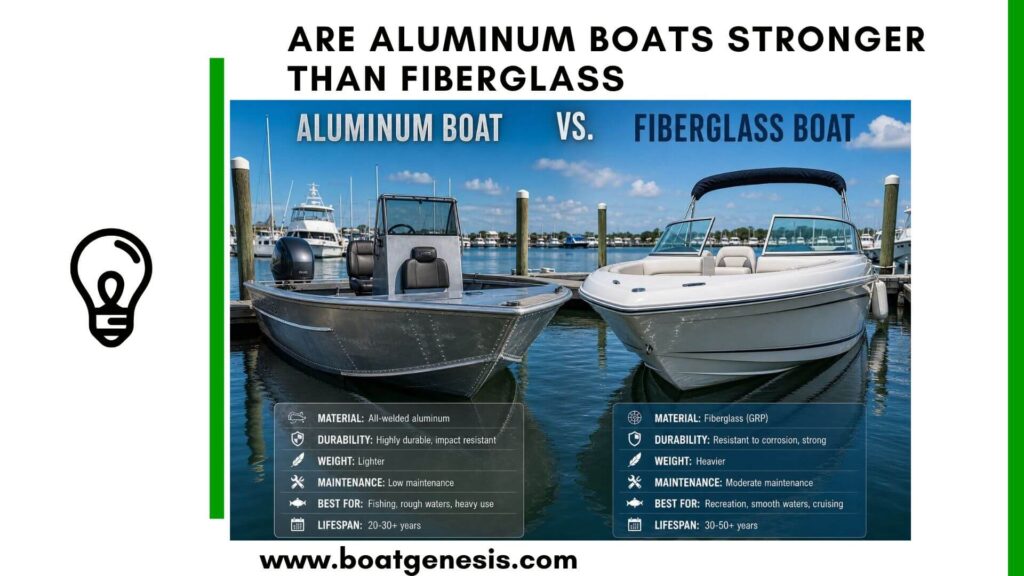
The honest answer? It depends on what “stronger” means to you. Aluminum wins in raw toughness and impact resistance. Fiberglass wins in ride quality and long-term appearance. Neither material is universally better — they’re built for different lifestyles, budgets, and waters.
This article breaks it all down so you can stop guessing and start deciding.
Key Takeaways
| Factor | Aluminum | Fiberglass |
|---|---|---|
| Impact resistance | ✅ Much higher | ❌ Cracks more easily |
| Weight | ✅ Lighter | ❌ Heavier |
| Ride comfort | ❌ Noisier, rougher | ✅ Smoother, quieter |
| Saltwater durability | ⚠️ Needs rinsing | ✅ Naturally corrosion-resistant |
| Upfront cost | ✅ Cheaper | ❌ More expensive |
| Long-term maintenance | ⚠️ Simpler but more frequent | ✅ Less frequent, harder repairs |
| Resale value | ⚠️ Moderate | ✅ Often better |
| Best for | Fishing, shallow/rocky water, trailering | Offshore, open water, long cruises |
- Key Takeaways
- What Does "Stronger" Actually Mean?
- Aluminum Boats: Where They Shine (and Where They Don't)
- Fiberglass Boats: Where They Shine (and Where They Don't)
- Head-to-Head Comparison: The Key Categories
- The Real Cost Picture: Upfront vs. Long-Term
- What Kind of Boater Are You? A Simple Decision Guide
- How Hull Design Affects the Comparison
- Environmental Conditions: Matching Material to Your Waters
- FAQ: Aluminium vs Fibreglass Boats
- Q: Are aluminum boats safer than fiberglass?
- Q: Do aluminum boats last as long as fiberglass?
- Q: Is aluminum or fiberglass better for saltwater?
- Q: Why are fiberglass boats more expensive?
- Q: Can you repair an aluminum boat yourself?
- Q: Which type of boat holds its value better?
- Q: Are fiberglass boats faster than aluminum?
- Q: What about a fiberglass boat with an aluminum hull? Do those exist?
- Conclusion
What Does “Stronger” Actually Mean?
This question trips people up because strength isn’t one thing. In materials science, you can measure:
- Impact strength — how well it resists a sudden blow (think hitting a submerged rock)
- Tensile strength — how well it resists being pulled apart
- Stiffness — how much it flexes under load
- Fatigue strength — how it holds up over years of repeated stress
Aluminum scores higher in impact and shear strength — roughly 10 times the shear strength of fiberglass. That’s why aluminum boats are so popular in shallow rivers and rocky lakes where hitting something underwater is a real possibility.
Fiberglass, on the other hand, offers excellent stiffness and fatigue resistance. It handles long-term wave stress very well, which is why you see it dominating the offshore and bluewater market.
Neither material “beats” the other — they just excel in different types of strength.
Aluminum Boats: Where They Shine (and Where They Don’t)
The Strengths
Aluminum is tough. You can drag an aluminum jon boat over gravel, bump into a dock at 5 mph, or scrape a rocky bottom — and the hull will dent rather than crack. Dents don’t sink boats. Cracks might.
It’s also lighter than fiberglass of comparable size, which means:
- Better fuel efficiency at the same horsepower
- Easier towing with a smaller truck
- Faster acceleration at lower RPMs
For freshwater anglers, duck hunters, or anyone who regularly launches on rough ramps or trailheads, that lightweight toughness is genuinely valuable.
The Weaknesses
Aluminum flexes more than fiberglass, which translates to a noisier ride. Waves slap against the hull and the sound travels right through the metal. Some people barely notice it; others find it exhausting on long runs.
Aluminum also corrodes in saltwater if you’re not careful. It won’t rust the way steel does, but electrolytic corrosion (galvanic corrosion) can quietly eat through fittings and hull material if you leave the boat in saltwater for extended periods without proper maintenance.
==>> Also read: Can you fiberglass an aluminum boat?
Want to avoid costly fiberglass boat repair mistakes?
Learn how to inspect damage properly, decide when to DIY, and prevent expensive fiberglass problems before they start.
Fiberglass Boats: Where They Shine (and Where They Don’t)
The Strengths
Fiberglass absorbs vibration rather than amplifying it. That’s why offshore fishing boats and cruisers are almost universally fiberglass — a 40-mile run across open water in a fiberglass hull is dramatically more comfortable than the same run in aluminum.
The material is also naturally corrosion-resistant, making it the clear choice for saltwater environments where aluminum requires ongoing attention. Fiberglass holds its finish better, so boats often look newer for longer — which matters at resale time.
The Weaknesses
Fiberglass is heavier and more expensive. A comparable fiberglass boat will typically cost more to buy, more to tow (you may need a larger truck), and more to repair when something goes wrong.
And something will go wrong eventually. Fiberglass repairs — even small ones — often require professional help. Osmotic blistering (water seeping into the laminate) is a real risk if the hull isn’t maintained, and fixing it isn’t cheap or fun.
Head-to-Head Comparison: The Key Categories
Durability & Impact Resistance
Winner: Aluminum
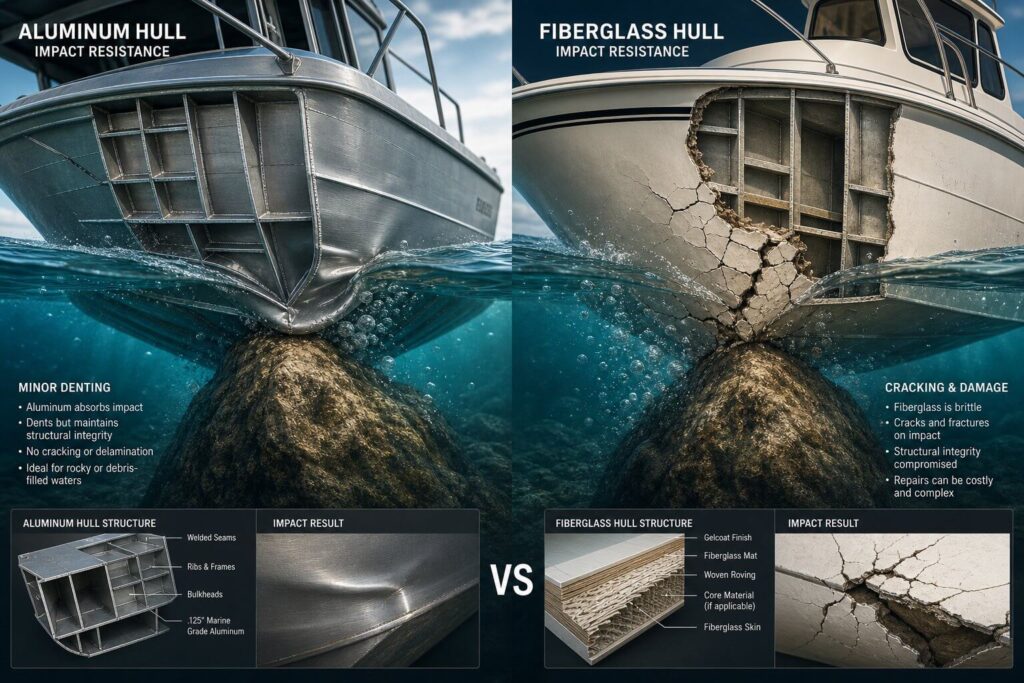
Aluminum handles sudden impacts better. If you run aground or clip a rock, aluminum will dent and deform — but it stays watertight far more often than fiberglass, which can crack, delaminate, or shatter on a hard impact.
That said, minor surface damage (scratches, scuffs) shows more obviously on aluminum than on gel-coated fiberglass.
Ride Quality & Comfort
Winner: Fiberglass
The heavier, stiffer construction of fiberglass cuts through chop instead of bouncing over it. Passengers notice the difference immediately, especially in anything above a 1-foot swell. Fiberglass hulls also run quieter, which matters on long days on the water.
Fuel Efficiency
Winner: Aluminum
Lighter weight means less horsepower required to reach the same speed. Over a full season, aluminum boat owners often spend noticeably less on fuel — especially on smaller engines in the 40–150 hp range.
Saltwater Suitability
Winner: Fiberglass
Fiberglass doesn’t corrode. Full stop. Aluminum can absolutely handle saltwater, but it demands consistent maintenance: thorough freshwater rinsing after every use, sacrificial anodes checked and replaced regularly, and vigilance around dissimilar metals (stainless steel fittings touching aluminum can accelerate corrosion).
Repairability
Winner: Aluminum
A dented aluminum hull can often be hammered or pulled back into shape by a competent fabricator. Small holes can be welded. Fiberglass repairs require grinding, laminating, and finishing — a multi-step process that most boat owners outsource to a professional.
Long-Term Value & Resale
Winner: Fiberglass (usually)
Fiberglass boats tend to hold their cosmetic appeal longer and command stronger resale prices in many markets, particularly for larger boats. Well-maintained aluminum fishing boats and utility craft do hold value well in their own market segment, but the premium end of the boat market runs almost exclusively on fiberglass.
This guide helps boat owners understand fiberglass damage clearly — what matters, what doesn’t, and when repairs are truly necessary, so small issues don’t turn into expensive mistakes.
See What Every Boat Owner Should Know →The Real Cost Picture: Upfront vs. Long-Term
One of the biggest factors people overlook is the total cost of ownership, not just the sticker price.
Aluminum: Lower Entry Cost, Higher Maintenance Frequency
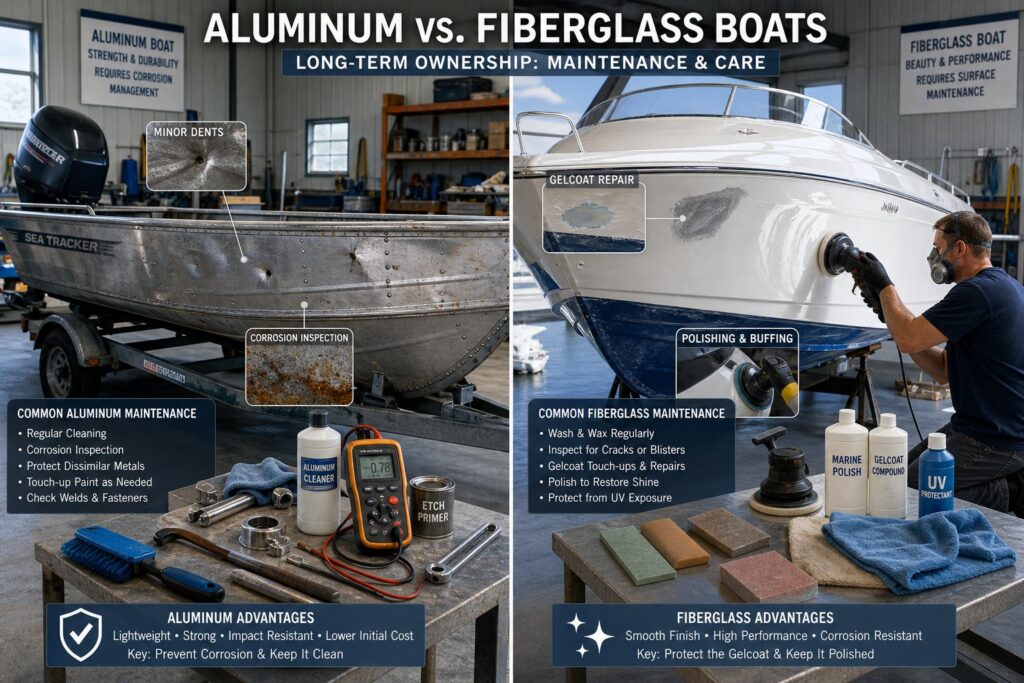
A comparable aluminum boat will typically cost 10–30% less than fiberglass at purchase. Maintenance tasks (rinsing, touching up paint, replacing anodes) are simple enough that most owners do them at home. But you’ll do them more often.
Fiberglass: Higher Upfront, Lower Maintenance Frequency
You’ll pay more to get into a fiberglass boat. But if you wax it twice a year and inspect for osmotic blistering periodically, the routine maintenance burden is lower than aluminum in saltwater environments. When something does need fixing, however, expect to open your wallet.
What Kind of Boater Are You? A Simple Decision Guide
Choose aluminum if you:
- Fish rivers, lakes, or shallow inshore waters regularly
- Launch on rough or gravel ramps
- Tow with a mid-size truck or SUV
- Want the lowest upfront cost
- Don’t mind some engine noise
- Like simple, DIY-friendly maintenance
Choose fiberglass if you:
- Boat offshore or in open water frequently
- Prioritize ride comfort on longer trips
- Keep the boat in saltwater (even occasionally)
- Want a quieter, smoother experience
- Plan to sell the boat in 5–10 years and want strong resale value
- Are willing to pay more upfront for less frequent (if more complex) repairs
How Hull Design Affects the Comparison
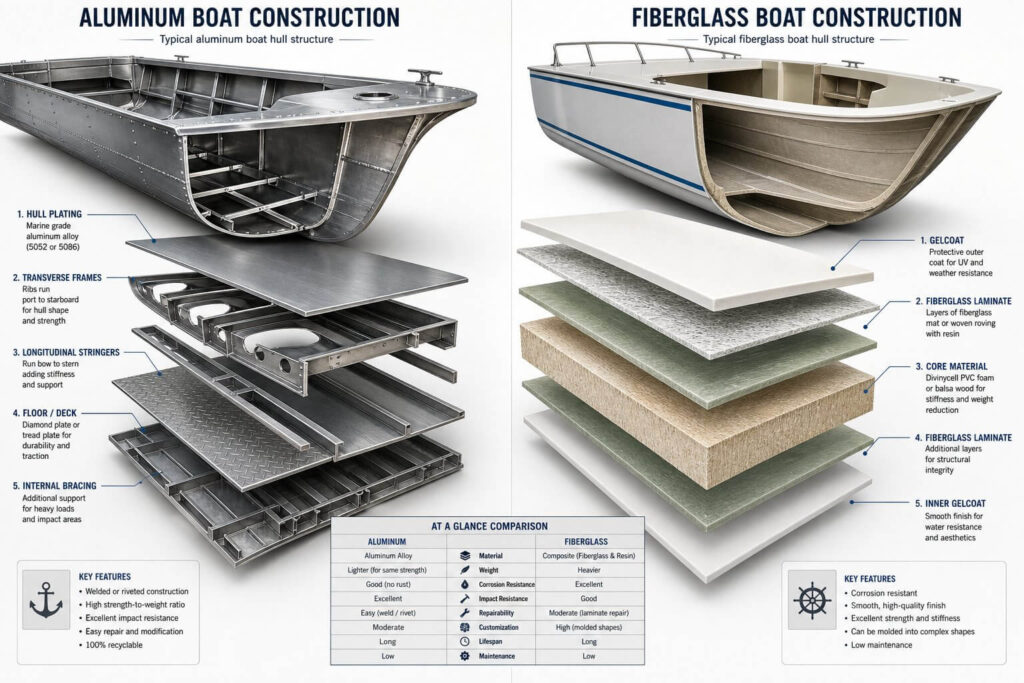
One thing people forget in the aluminum vs. fiberglass debate: hull design matters as much as material.
A deep-V aluminum hull will ride smoother than a flat-bottom fiberglass boat. A semi-V fiberglass hull might be slower and less fuel-efficient than a tunnel-hull aluminum craft. The shape of the hull affects speed, stability, draft, and handling in ways that can override material differences entirely.
When you compare boats, don’t just compare the material — compare hull designs too. A 19-foot deep-V aluminum walleye boat is a very different machine from a 19-foot fiberglass bass boat, even if they cost roughly the same.
Common Hull Types and Their Best Uses
| Hull Type | Typical Material | Best For |
|---|---|---|
| Flat bottom | Aluminum | Calm water, shallow areas, duck hunting |
| Jon boat | Aluminum | Rivers, marshes, fishing |
| Deep-V | Fiberglass or aluminum | Offshore, rough water, speed |
| Modified-V | Fiberglass | All-around use, family boating |
| Cathedral/tri-hull | Fiberglass | Stability, watersports |
| Pontoon | Aluminum frame | Lakes, leisure, entertaining |
Environmental Conditions: Matching Material to Your Waters
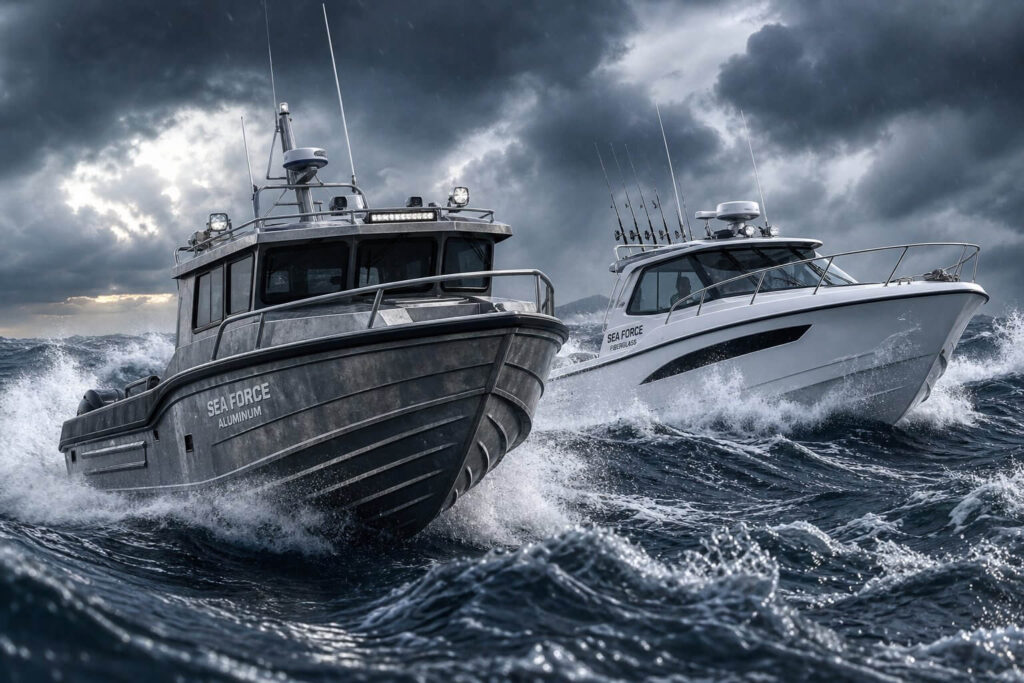
Where you boat should heavily influence which material you choose. This is an underrated part of the conversation.
Freshwater lakes and rivers: Either material works well here. Aluminum has a slight edge for shallow, rocky waters. Fiberglass wins for open lake cruising and comfort.
Coastal inshore (bays, estuaries, marshes): Aluminum can work but demands diligent saltwater maintenance. Fiberglass is more forgiving here.
Offshore and bluewater: Fiberglass, almost without exception. The ride quality, corrosion resistance, and hull strength at speed in open ocean conditions favor fiberglass decisively.
Cold climates: Both handle cold well, but aluminum can become more brittle at extreme low temperatures. Fiberglass is generally more stable across a wide temperature range.
Warm, humid climates: Watch fiberglass for osmotic blistering. Keep aluminum rinsed and anodes current.
FAQ: Aluminium vs Fibreglass Boats
Q: Are aluminum boats safer than fiberglass?
Both are safe when built properly. Aluminum is less likely to crack on impact, which some argue makes it safer in rocky conditions. Fiberglass is more stable in rough open water due to its weight. Neither material is inherently safer — it depends heavily on the hull design and conditions.
Q: Do aluminum boats last as long as fiberglass?
Yes, with proper care. Aluminum boats can easily last 30–50 years. Fiberglass boats maintained well can last just as long, and often retain their appearance better. Neglect either material and it will show much sooner.
Q: Is aluminum or fiberglass better for saltwater?
Fiberglass is generally the easier choice for saltwater because it doesn’t corrode. Aluminum can handle saltwater, but you must rinse it thoroughly after every use and maintain your sacrificial anodes to prevent galvanic corrosion.
Q: Why are fiberglass boats more expensive?
The manufacturing process is more labor-intensive and the materials (resins, gelcoat, core materials) cost more. Aluminum fabrication is simpler and faster, which keeps costs down.
Q: Can you repair an aluminum boat yourself?
Minor dents can sometimes be hammered out. Cracks and holes typically require welding — a skill most boat owners hire out. Compared to fiberglass, aluminum repairs are often quicker and cheaper when done by a fabricator.
Q: Which type of boat holds its value better?
It varies by segment. High-end fiberglass boats (offshore fishing boats, cruisers) tend to hold value well. Quality aluminum fishing boats and utility craft also retain solid value in their market. Brand, condition, and demand matter more than material in most cases.
Q: Are fiberglass boats faster than aluminum?
Not necessarily. Aluminum’s lighter weight actually makes it faster at the same horsepower in many cases. A lightweight aluminum deep-V can outrun a heavier fiberglass boat with the same engine.
Q: What about a fiberglass boat with an aluminum hull? Do those exist?
There are composite and multi-material builds, but most production boats are one or the other. Some manufacturers use aluminum structural components inside fiberglass hulls for added rigidity.
Conclusion
There’s no trophy winner in the aluminum vs. fiberglass boats debate — and anyone who tells you otherwise is probably trying to sell you something.
Pick aluminum if you’re fishing, hunting, or exploring water that’s shallow, rocky, and unpredictable. You want something you can bang around without wincing, tow with a modest vehicle, and maintain with a hose and some elbow grease.
Pick fiberglass if you’re heading offshore, running big open lakes, or spending long days on the water where comfort matters. You’re willing to invest more upfront for a quieter ride and a hull that shrugs off saltwater without a lot of fuss.
The best boat is always the one that fits your water, your habits, and your budget — not what looks impressive at the marina. Do your homework, take a few boats out on demo runs, and trust what you feel on the water more than what anyone tells you in the parking lot.
Discover Boating — Choosing the Right Boat — a comprehensive buyer’s guide covering hull types, engine choices, and first-time buyer considerations.

Warren is the founder of BoatGenesis and brings practical experience in fiberglass boat repair, marine equipment testing, and powerboat building. He has worked on a range of repair and restoration projects and now focuses on creating clear, research-based guides to help boat owners avoid costly mistakes and make smarter maintenance decisions. Learn more about Warren.