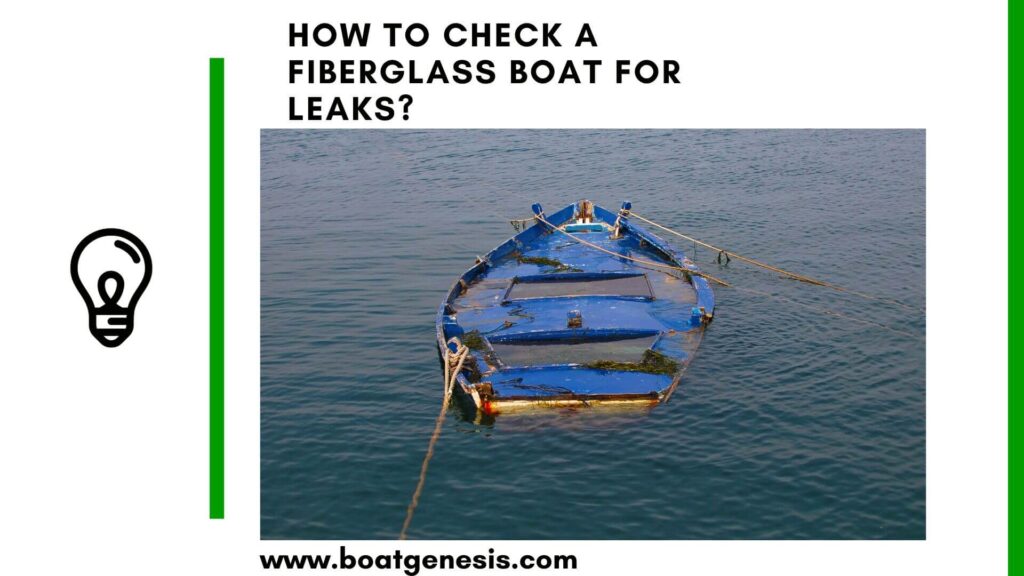
Finding a leak in your fiberglass boat can feel like searching for a needle in a haystack—especially when you’re dealing with slow seepage that only shows up under certain conditions. Whether you’ve noticed mysterious water in the bilge, spotted concerning soft spots on deck, or you’re conducting pre-season maintenance, knowing how to systematically check for leaks can save you thousands in repair costs and prevent catastrophic failures on the water.
After years of working on fiberglass boats, I’ve learned that most leaks follow predictable patterns. They typically occur at hardware penetrations, stress points, and aging sealant lines—all areas you can inspect yourself with basic tools and a methodical approach.
In this guide, I’ll walk you through the proven methods I use to detect leaks in fiberglass boats, from quick visual inspections to comprehensive water tests. You’ll learn where leaks commonly hide, what tools make detection easier, and how to distinguish between active leaks and cosmetic issues that don’t threaten your boat’s integrity.
- Understanding How Fiberglass Boats Leak
- Essential Tools for Leak Detection
- Step 1: Start with a Dry Bilge Visual Inspection
- Step 2: Inspect the Hull Exterior Thoroughly
- Step 3: Examine All Hardware Penetrations
- Step 4: Conduct a Comprehensive Hose Test
- Step 5: Perform a Static Water Test (For Serious Leak Hunting)
- Step 6: Use a Moisture Meter for Hidden Issues
- Step 7: Check Storage and Drainage Systems
- Addressing Discovered Leaks Promptly
- Preventive Maintenance to Avoid Future Leaks
- Frequently Asked Questions
- How often should I check my fiberglass boat for leaks?
- Can small gelcoat cracks cause leaks in a fiberglass boat?
- What's the difference between a leak and osmotic blistering?
- How do I find a leak in my boat if it only leaks when running?
- Should I hire a professional or can I check for leaks myself?
- What causes fiberglass boats to leak at the transom?
- Can I use my boat if I've found a small leak?
- How much does it typically cost to repair a fiberglass boat leak?
- Conclusion
Understanding How Fiberglass Boats Leak
Before you start your inspection, it helps to understand that fiberglass boats rarely leak through the laminate itself. The fiberglass hull is typically waterproof when properly constructed. Instead, leaks almost always occur at:
- Hardware penetrations: Through-hull fittings, transducers, cleats, rails, and deck hardware
- Joints and seams: Hull-to-deck joints, hatch seals, and window frames
- Impact damage: Cracks from collisions, groundings, or stress fractures
- Aging sealants: Deteriorated caulking around fittings and joints
Understanding this helps you focus your inspection on the most vulnerable areas rather than examining every square inch of gelcoat.
Essential Tools for Leak Detection
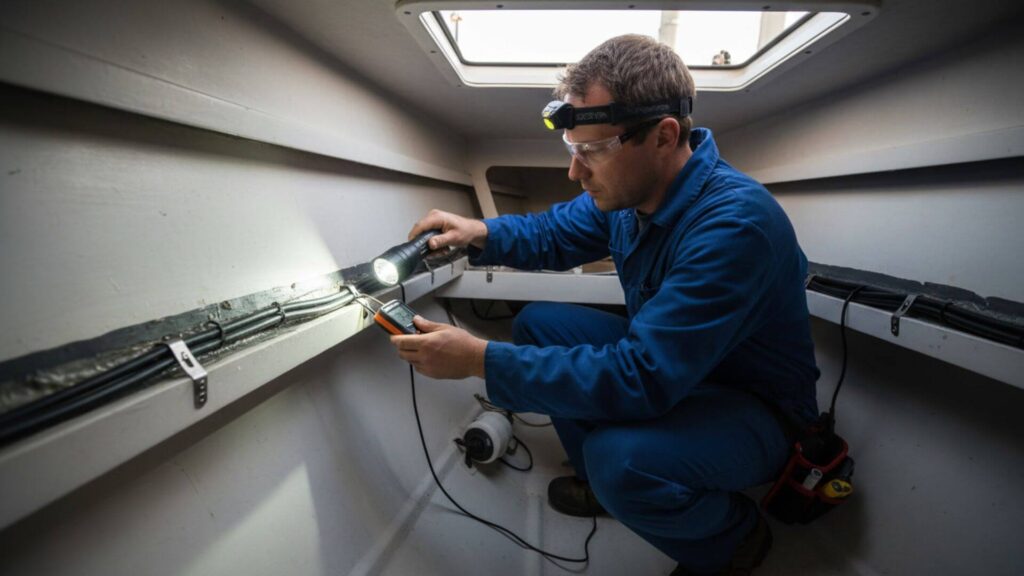
Having the right tools makes leak detection significantly easier:
- Moisture meter: A pin-type or pinless moisture meter helps detect hidden water intrusion in the laminate and core materials
- Flashlight or headlamp: Essential for inspecting dark bilge areas and tight spaces
- Dry paper towels or rags: Useful for wiping surfaces to check for active seepage
- Marking tape or chalk: To mark suspect areas for monitoring
- Inspection mirror: Helps you see behind and under difficult-to-access areas
- Garden hose with spray nozzle: For conducting targeted water tests (optional but recommended)
A quality moisture meter is worth the investment if you own a boat. Models designed for marine use can help you detect problems long before they’re visible to the naked eye.
Step 1: Start with a Dry Bilge Visual Inspection
Begin your leak check with the bilge completely dry. If there’s standing water, pump it out and use towels to dry all surfaces thoroughly. This gives you a clean baseline.
What to look for:
- Oil sheens or fuel odors (indicating different problems)
- Water stains or mineral deposits showing previous water paths
- Rust on fasteners or engine components
- Soft or spongy areas when pressing on the bilge floor
Run your boat’s bilge blower or use a fan to ensure complete drying. In humid climates, this might take several hours. Take photos of the dry bilge so you can compare after testing.
Pro tip: Many boaters install absorbent bilge pads in their bilge area. These change color when wet, providing an early warning system for leaks between trips.
Step 2: Inspect the Hull Exterior Thoroughly
Conduct your exterior hull inspection with the boat out of the water, ideally on a trailer or in dry storage where you can access all areas.
Check High-Stress Areas First
Focus your initial inspection on areas that experience the most stress and impact:
Want to avoid costly fiberglass boat repair mistakes?
Learn how to inspect damage properly, decide when to DIY, and prevent expensive fiberglass problems before they start.
- Keel and bottom: Look for gouges, scrapes, or cracks from groundings
- Chines: The corners where bottom and sides meet often develop stress cracks
- Bow area: Impact zone that takes the most pounding from waves
- Stern and transom: Especially around outdrive or motor mounts
Identify Gelcoat vs. Structural Damage
Not every crack or blemish indicates a leak. Learn to distinguish between:
- Spider cracks: Fine surface cracks in gelcoat that rarely penetrate to the laminate
- Stress cracks: Deeper cracks that flex when pressed, indicating potential laminate damage
- Osmotic blisters: Raised bumps filled with fluid, suggesting moisture in the laminate
- Soft spots: Areas that feel spongy when pressed, indicating delamination or saturated core material
Press firmly but carefully on suspect areas. Solid fiberglass should feel rigid. Any flexing or movement suggests compromised structure that could allow water intrusion.
If you find soft spots or extensive blistering, you may be dealing with more serious issues.
Step 3: Examine All Hardware Penetrations
Hardware mounted through the hull or deck creates potential leak points. Every hole is a vulnerability if not properly sealed.
Deck Hardware Inspection
Check each piece of deck hardware systematically:
- Cleats and rails: Look for gaps between the base and deck surface
- Hatches: Inspect rubber seals and mounting bolts
- Windshield and window frames: Check sealant lines for cracks or separation
- Anchor windlass and rod holders: Common leak sources on older boats
Apply gentle upward or sideways pressure to each fitting. Movement indicates loose fasteners or failed sealant. You shouldn’t see any flexing or feel any give.
Through-Hull Fittings Below the Waterline
These are critical—any leak here means water enters whenever the boat is in the water:
- Transducers: Sonar and depth finder through-hulls
- Live well intakes and drains
- Bilge pump discharge fittings
- Speedometer pickups
Check inside and outside for:
- Corrosion or deterioration around the fitting
- Cracks in the fiberglass around the installation
- Signs of weeping or moisture trails
- Proper bedding compound seal
Marine sealant eventually hardens and cracks with age and UV exposure. If your boat is more than 5-7 years old and fittings haven’t been rebedded, this is often the culprit for mysterious leaks.
For rebedding hardware, marine-grade sealants provide long-lasting waterproof bonds. The choice between flexible (4200) and permanent (5200) depends on whether you’ll need to remove the hardware in the future.
Step 4: Conduct a Comprehensive Hose Test
A targeted hose test helps you identify the exact source of leaks, especially around deck hardware and the hull-to-deck joint.
How to Perform an Effective Hose Test
- Position someone in the bilge: Have a helper monitor the interior with a flashlight while you spray water on the exterior
- Work systematically from top to bottom: Start at the highest points and work down, so water doesn’t drip from above and confuse your findings
- Focus water on suspect areas: Spray around each hardware fitting, along seams, and at any visible cracks for 30-60 seconds each
- Have your helper call out any water appearance: They should watch for drips, seepage, or streams appearing inside
Be patient during this process. Some leaks take time to show up, especially if water needs to work through deteriorated bedding compound or travel along seams.
Pay Special Attention to the Hull-to-Deck Joint
The seam where the hull and deck join is a common leak source on older boats. This joint is typically sealed with sealant and mechanical fasteners, and it can deteriorate over time.
Spray water heavily along this seam while your helper watches the interior. Look for:
- Water running down the inside of the hull liner
- Drips appearing at regular intervals (where fasteners penetrate)
- Moisture wicking along the joint line
Step 5: Perform a Static Water Test (For Serious Leak Hunting)
If you haven’t located the leak with visual inspection and hose testing, a static water test can reveal even the slowest leaks.
Important safety note: Only perform this test with the boat adequately supported on a trailer or stands. Never fill a boat with water unless you’re certain it can handle the additional weight without structural damage.
Conducting the Test
- Seal all intentional drains: Close seacocks, plug the drain plug, and ensure the bilge pump isn’t set to auto
- Add measured water: Use a hose to add several inches of water to the bilge
- Mark the water level: Use a piece of tape or chalk to mark the exact level on the bilge sides
- Monitor over 24 hours: Check the level periodically to see if it drops
What the results mean:

This guide helps boat owners understand fiberglass damage clearly — what matters, what doesn’t, and when repairs are truly necessary, so small issues don’t turn into expensive mistakes.
See What Every Boat Owner Should Know →- No water loss: Your hull is sound below that water level
- Slow, steady drop: You have a small leak, likely at a through-hull or hull penetration
- Rapid loss: Significant leak requiring immediate attention
If water level drops, use dry towels to wipe around all fittings and seams at and below the water level. The source will remain damp or wet while other areas dry.
Step 6: Use a Moisture Meter for Hidden Issues
Moisture meters are invaluable for detecting water intrusion that isn’t yet visible. This is especially important for cored decks and hulls, where water can saturate the core material without obvious external signs.
How to Use a Moisture Meter on Fiberglass
- Take baseline readings on known-dry areas: This establishes what “normal” looks like for your boat
- Scan systematically: Work in a grid pattern across decks and hull sides
- Pay extra attention around hardware: These areas often show elevated readings first
- Mark elevated readings for monitoring: Some moisture may be from rain on deck, so recheck after the boat has been covered for several days
Elevated moisture readings don’t always mean active leaks—they might indicate old water intrusion that’s dried. But any readings significantly above baseline warrant investigation.
Quality marine moisture meters typically range from $100-400 and can detect problems worth thousands in repairs.
Step 7: Check Storage and Drainage Systems
Sometimes what appears to be a hull leak is actually water from other sources.
Common “False Leak” Sources
- Condensation: Temperature changes cause moisture to form on cold surfaces
- Rain water: Inadequate deck drainage allows water to accumulate and find paths below
- Bait tank or live well overflow: Plumbing issues that drain into the bilge
- Anchor locker drainage: Should drain overboard but sometimes routes to bilge
- Ice chest or cooler drain
Check that all drains and scuppers are clear and flowing properly. Many boats have drainage systems that route deck water through channels before exiting through the transom or hull sides.
Addressing Discovered Leaks Promptly
Once you’ve identified leak sources, prioritize repairs based on severity:
Immediate priority (fix before next use):
- Below-waterline through-hull leaks
- Structural cracks that flex or weep
- Transom issues near motor mounts
Important (fix within weeks):
- Deck hardware leaks that allow water into core material
- Hull-to-deck joint seepage
- Window or hatch seal failures
Monitor (check regularly, fix seasonally):
- Minor gelcoat cracks above waterline
- Slightly loose hardware that isn’t leaking yet
- Cosmetic blisters without fluid
For most hardware leaks, the solution involves removing the fitting, cleaning old sealant, and rebedding with fresh marine sealant. This is a straightforward DIY project for most boat owners.
For structural repairs, delamination, or extensive damage, consult a professional fiberglass repair shop. Some repairs require specialized skills and materials to ensure structural integrity.
==>>Related article: fiberglass boat leak repair
Preventive Maintenance to Avoid Future Leaks
The best approach to leaks is preventing them in the first place:
- Annual inspection routine: Check all fittings, seals, and hardware before each season
- Rebed hardware proactively: Don’t wait for leaks; rebed deck hardware every 5-7 years
- Cover your boat properly: UV degrades sealants; good covers extend their life significantly
- Address impacts immediately: Don’t ignore groundings or collisions—inspect and repair promptly
- Keep bilge clean and dry: A clean bilge makes leak detection much easier
Using quality marine products makes a difference. Cheap automotive silicone won’t last in the marine environment. Invest in proper marine sealants, UV-resistant fittings, and corrosion-resistant fasteners.
Consider keeping a leak detection kit on board for quick checks and emergency repairs.
Frequently Asked Questions
How often should I check my fiberglass boat for leaks?
Conduct a thorough leak inspection at least once per year, ideally before launching for the season. Additionally, check after any impact, grounding, or if you notice increased bilge pump activity. During the boating season, a quick visual bilge check before each outing takes just minutes and can catch problems early.
Can small gelcoat cracks cause leaks in a fiberglass boat?
Surface-level gelcoat crazing or spider cracks typically don’t cause leaks—they’re cosmetic issues in the protective coating. However, deeper stress cracks that penetrate through the gelcoat into the laminate can absolutely leak. The test is whether the crack flexes when you press on it. Flexing indicates structural compromise that can allow water intrusion.
What’s the difference between a leak and osmotic blistering?
A leak allows water to enter the boat through a crack, failed seal, or penetration. Osmotic blistering (boat pox) occurs when water penetrates the gelcoat and reacts with uncured resins in the laminate, creating fluid-filled blisters. Blisters can eventually lead to leaks if left untreated, but they’re a separate issue requiring different repair approaches [link to related article about osmotic blistering repair].
How do I find a leak in my boat if it only leaks when running?
Leaks that only appear underway typically occur at through-hull fittings, the outdrive seal, or stress cracks that open under load. These are harder to diagnose because you need the boat running and under stress. Options include: having someone watch the bilge during a test run, using a moisture meter immediately after running, or conducting hose tests while simulating engine vibration.
Should I hire a professional or can I check for leaks myself?
Most boat owners can perform basic leak detection themselves using the methods in this guide. You’ll need to hire a professional surveyor or repair technician if you find evidence of serious structural damage, extensive blistering, significant soft spots, or if your DIY inspection reveals problems you’re not comfortable diagnosing. A professional marine survey costs $15-20 per foot but provides comprehensive documentation of your boat’s condition.
What causes fiberglass boats to leak at the transom?
Transom leaks commonly result from: deteriorated sealant around outdrive or outboard mounting bolts, stress cracks from engine torque and vibration, failed seals where the outdrive penetrates the transom, or water intrusion into a cored transom causing rot and delamination. Transom issues can be serious—this area carries significant structural loads and must remain watertight.
Can I use my boat if I’ve found a small leak?
It depends on the leak’s location and severity. A tiny above-waterline deck fitting leak that drips a cup of water per trip isn’t an emergency (though you should fix it soon). A below-waterline through-hull leak or any leak that allows significant water intrusion requires immediate repair before using the boat. When in doubt, fix first, boat later—getting stranded or sinking isn’t worth the risk.
How much does it typically cost to repair a fiberglass boat leak?
Simple repairs like rebedding a deck fitting cost $50-150 in materials if DIY, or $200-500 for professional work. Structural fiberglass repairs range from $300-1,000 for small areas to $3,000-10,000+ for extensive damage, transom rebuilds, or major hull repairs. Early detection and repair saves significant money compared to addressing advanced deterioration.
Conclusion
Checking your fiberglass boat for leaks doesn’t require professional equipment or expertise—just a systematic approach and attention to detail. By starting with visual inspections, examining hardware penetrations, conducting water tests, and using tools like moisture meters strategically, you can identify leak sources before they cause serious damage.
Remember that most leaks start small. That slight dampness in the bilge or minor soft spot on deck will worsen over time if ignored. The hour or two you invest in a thorough leak inspection can prevent thousands in repair bills and give you peace of mind on the water.
Make leak detection part of your regular maintenance routine. Your boat will reward you with years of reliable, dry service—and you’ll spend less time pumping bilges and more time enjoying what you bought the boat for in the first place.
Now that you’ve identified any leaks, it’s time to fix them properly. You should also read my fiberglass boat leak repair guide here.

Warren is the founder of BoatGenesis and brings practical experience in fiberglass boat repair, marine equipment testing, and powerboat building. He has worked on a range of repair and restoration projects and now focuses on creating clear, research-based guides to help boat owners avoid costly mistakes and make smarter maintenance decisions. Learn more about Warren.